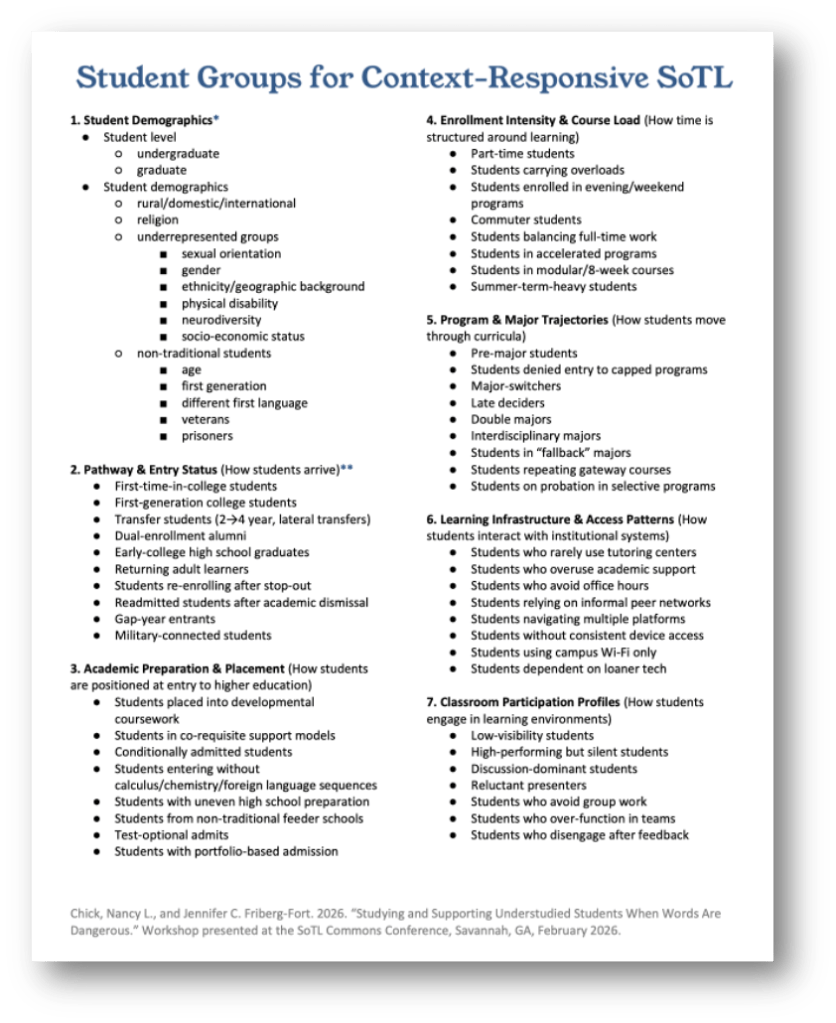
“Student Groups for Context-Responsive SoTL“ names specific ways of thinking about who we study in SoTL. Rather than imagining a generic or ideal student, this resource invites scholars to design projects that focus on particular groups of students whose experiences are often underexamined. Narrowing the analytic lens in this way can make SoTL projects more manageable, while also enabling more precise insight into how learning unfolds differently for different students.
The document moves beyond demographics alone to include groupings based on pathways and entry status, enrollment intensity, participation profiles, and interactions with institutional systems. By drawing attention to how students arrive, how they move through curricula, and how they navigate learning environments, the framework supports more nuanced, context-responsive analyses of learning—ones that help locate difference in institutional structures and educational design, not just in students themselves.
How you might use this resource
- To identify analytically relevant groupings for a specific SoTL study
- To avoid defaulting to demographic categories when they aren’t possible or the best fit
- To design studies that connect learning experiences to institutional structures
- To broaden conversations about equity, access, and support

Leave a comment