by Daniel Guberman
Of all of the barriers to SoTL right now, we don’t want the IRB to be another. Fear of the IRB process is the most common barrier I heard from faculty across numerous disciplines when it comes to the potential to do SoTL work. This fear largely falls into the “fear of the unknown” category. Even scholars who work with the IRB regularly for human subjects research involving medical procedures share fear about the IRB when it comes to their classes.
In this blog post I implore you to not be scared, and if you are scared (there’s a reason you are still reading), I share a few key tips to keep in mind that might make navigating the process easier.
Tips for Navigating the IRB Process
1. You Cannot Fail an IRB Submission
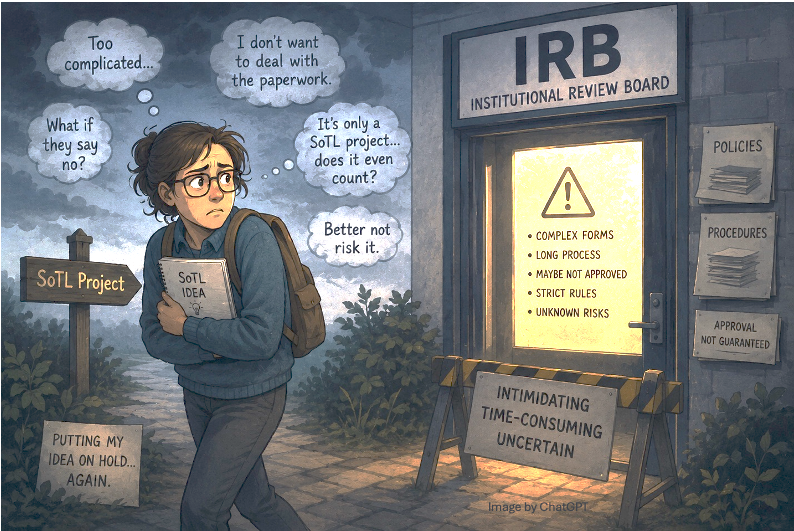
While many of us implore that our students embrace and learn from failure, this is much easier to do when we are in control. As academics who have navigated very complex educational structures many of us feel like we might be beyond the point where we want to have someone else tell us we have failed. We might even have developed comfort accepting cruel reviews of our work through the peer review system and brushing it off, but the idea of a faceless institutional operative declaring that our research is unethical seems to cross a line.
The fact is, there is no failing an IRB submission. You will never be told your submission is so poorly constructed that you are now banned from submitting further proposals. In fact, for many, the IRB process is what we hope peer review to be, a mix of two primary types of comments:
- Questions requesting greater clarity about what exactly we are planning to do as part of our research process; and
- Suggestions for how we can do our research in more ethically sound ways.
While the IRB is very different than peer review, because they are not reading as peers, we should recognize that like our peers many of these staff members or faculty volunteers are overworked and may be reading quickly, and in doing so may not grasp the whole of our plan, so be kind in answering questions that derive from their confusion.
Tip 2. The IRB is Your Friend, but Not that Kind of Friend
Above, I compared the IRB to peers in the peer review process, and this view has benefits, but it can also be misleading. Many, myself included, initially when embarking on their first SoTL projects think perhaps the IRB will serve as a good resource to help determine if a study is well-designed to achieve its goals. In fact in many IRB submissions some of the first questions ask about the purpose of the research and how you plan to go about doing it. But an IRB reviewer is not actually concerned with whether your methodological approach is appropriate to answer your research question. They are looking at whether your plan for the humans involved in your research (most often your students) are going to be treated ethically and appropriately. The IRB serves as a partner with this specific purpose, and when we are bringing research into our classrooms with students serving as the subjects, this is a particularly valuable purpose, but remember that their purpose is limited.
Tip 3. Answer What You Are Asked
For many scholars the first time they complete an IRB submission for a SoTL project they are excited, and they have probably thought about it for months, sometimes years, and they want to get it out there. Because the IRB submission frequently happens at the start of this process, it becomes the first opportunity to put ideas into words, and that leads to writing a lot. Writing too much. People will describe the entire redesign of their class with brand new learning outcomes, a wide range of activities, and assignments, all just to get to the ultimate research request of sending out a survey to students in the middle and end of the semester. While some reviewers may absolutely love reading syllabi and assignment descriptions for fun (no judgment, I do myself), often these expansive descriptions can be confusing as they try to understand what data you are actually collecting from these activities for research purposes. The goal is not to hide information from the IRB, but to answer questions in light of their purpose, which is to ensure human subjects of research are treated appropriately. In many cases they will ask specific questions and you should restrict your answer to the specifics of that question.
The Three Most Common Types of Classroom SoTL Research
Every IRB treats things a little differently, so my goal here is not to make definitive statements, but in most cases, SoTL work falls into three broad categories, all of which are generally considered exempt (exempt does not mean you don’t need approval, it means you do not need continuing oversight, but this determination must be made). At my own institution, the IRB has started determining that some SoTL projects “are not human research” which is an odd phrasing since they are, but this still indicates they have reviewed it with a number and paper trail in their system.
Type 1. Studying what you plan to do in your class anyway
The most common form of SoTL studies involve analyzing existing or new teaching methods based on efforts to study the impact these efforts have on students. This includes both specific aspects of the class, including assignments, activities, materials, as well as broader strategies, like changing to specifications grading. Analysis in these contexts often involves the work students produce, instructor observations, and surveys or other feedback mechanisms designed to understand the impacts of these changes.
For example, when I first restructured my class with an ungrading structure, I didn’t expect the final grades would give me meaningful information, so instead I included questions about the class in student reflections, and I used a survey about the learning climate and student motivation, as I believed that the new structure would better internalize motivation (Guberman 2021a). Both of these strategies were primarily rooted in my desire to determine if I should continue with this new structure and how I could improve it, but the data doubled as information that could be shared more widely as a case study.
Type 2. Benign Surveys, Focus Groups, and other Data
As part of a teaching center who works with faculty on both course design and broader questions, I often get invited to conduct focus groups with students that reach beyond the scope of a single class. While the information does often get used in the context of course improvement, the data collection is not really part of an individual course, so this falls into a different category. My IRB refers to these tools as benign, meaning that they are unlikely to cause potential risk or harm even if my anonymization protocols fail.
For example, I worked with one department to conduct focus groups with students about class attendance in response to concerns about attendance declines after the university returned to normal operations following the Covid-19 pandemic. This is not a part of any one class, so it does not fall into the category above, even though it was designed to inform teaching practices across multiple classes. This can also be used to conduct studies across multiple classes using common surveys or collecting common data. This structure can also be very useful for gathering faculty perspectives on topics (Karcher et al. 2022).
Type 3. Analyzing Existing Data
Every instructor probably has years of data, whether inside an LMS or in a filing cabinet, which is how I used to maintain all of my students’ paper final exams in case anyone actually wanted to pick them up. This data can also be used for research about our teaching. I offer a word of caution though. It might be tempting to plan a study in the first category above and decide it might be easier to just wait until after the class and submit the IRB form claiming it is now all existing data and wait to submit the form. To me and likely to your IRB, this is not an ethical approach. If you know that you want to study some element of your class or teaching you should get approval pro-actively. Where you might bring in existing data is if you want to compare these changes to what you have been doing in the previous years.
For example, my colleague worked with an instructor who wanted to prioritize higher order thinking skills in his introductory economics class. In doing so he changed many aspects of the course structure but left most of the final unchanged (it had a mix of higher and lower order questions already). To understand the effects of this change they had to compare student performance on the finals going forward (the first category) with existing data that they previously had not anticipated studying (existing data) (Josephson et al. 2020). Yes, in many cases involving existing data you may be using two different categories. In my own work, after switching careers from faculty to academic development I learned a lot more about studies of intercultural competence, and this made me rethink a class that I had taught at my previous institution about heavy metal music. It was looking unlikely that I would teach this class again at my new institution, but I still thought that these insights were worth sharing, so I approached that work as a retroactive case study (Guberman 2021b).
References
Karcher, Elizabeth, Daniel Guberman, Emily Bonem, and John Lumkes. 2022. “Instructor Perception of Incorporating Active Learning in College of Agriculture Classrooms.” Teaching & Learning Inquiry 10. https://doi.org/10.20343/teachlearninqu.10.36
Guberman, Daniel. 2021a. “Student Perceptions of an Online Ungraded Course.” Teaching & Learning Inquiry 9 (1): 86-98. https://doi.org/10.20343/teachlearninqu.9.1.8
Guberman, Daniel. 2021b. “Teaching Intercultural Competence through Heavy Metal Music.” Arts and Humanities in Higher Education 20 (2): 115-132. https://doi.org/10.1177/1474022220903403
Josephson, Anna, Larry DeBoer, Dave Nelson, and Angelika Zissimopoulos. 2020. “Facilitating Higher Order Learning: Examining Student Outcomes after a Course Redesign.” Applied Economics Teaching Resources (AETR) 2 (2): 14-29. https://doi.org/10.22004/AG.ECON.302618
