by Diana Botnaru
In 1974, the year I was born in the Soviet Union, Aleksandr Solzhenitsyn was stripped of his Soviet citizenship for publishing The Gulag Archipelago (Solzhenitsyn 1974), a book banned by the state. In my family, we did not need to read the book to learn about the horrors of state sanctioned oppression, arbitrary arrests and labor camps. This reality, this truth, was woven into our own family history, carried from one generation to the next through stories.
Only years later, as an educator and SoTL scholar, did I come to see these stories as lessons about learning itself: fear shapes not only what people say, but how they learn. We know that context shapes meaning and that learning is never separate from the conditions in which it occurs. I don’t remember being explicitly told that some words were forbidden or risky, but some of my fear most likely predates my birth and are embodied in my family’s experience. I share two of my stories today, not just as a record of the past, but as a reminder that they shaped how I learned to speak, what I learned to keep silent, and how I came to understand authority, knowledge, and risk.
Stories of Silence and Survival
Tens of thousands of families in Basarabia (current day Republic of Moldova) paid a heavy price for the Soviet occupation in 1940. In the summer of 1941, the Soviet regime carried out the first wave of deportations that included my maternal great-aunt (Deportari.org, n.d.). Loaded into cattle cars and separated from her husband, she and her four children—all under the age of twelve—were sent to Siberia. Their alleged crime – family members of an “enemy of the people” – was a label reserved for perceived opponents of the regime. While her husband perished in another labor camp, she, forced to work at a logging site in Siberia, lived to tell her story.
My maternal grandfather was an Orthodox priest. Together with my grandmother, he survived two world wars, took refuge in Romania, endured a forced return back to the Soviet Union, and spent time in a transit camp where they awaited their fate. Fortunately, they were released, but that was not a guarantee. Of their kids, my uncle Andrei was denied entry into medical school, my uncle Mihai was almost stripped of his teaching college diploma and my mom was asked to deny her father in exchange for a good grade in a physical education class.
The Conditions That Make Learning Possible
While these stories taught me that ordinary characteristics and beliefs could become liabilities when they challenge accepted narratives, they also highlighted an enduring lesson about learning: when questioning carries risk, conformity becomes a strategy for survival. Such lessons do not remain confined to childhood or the classroom; they shape how people engage with knowledge throughout their lives. As scholars, we are expected to ask difficult questions, yet when inquiry comes with consequences, curiosity narrows. Questions become safer, less exploratory, or disappear altogether. Intellectual risk-taking requires a belief that disagreement and honest inquiry will not be punished.
The lesson I carry from childhood is therefore not simply about fear, but about the conditions that make learning possible. Throughout history, labels and categories have often been used to determine who belongs, whose perspectives are valued, and whose voices can be dismissed. Although the stakes today differ from those faced by my family, educational systems continue to exert explicit and implicit pressures that shape what can be questioned, challenged, or discussed. As educators, our responsibility is to recognize those pressures and cultivate communities where uncertainty is welcomed, difficult questions can be explored thoughtfully, and intellectual courage is supported rather than discouraged.
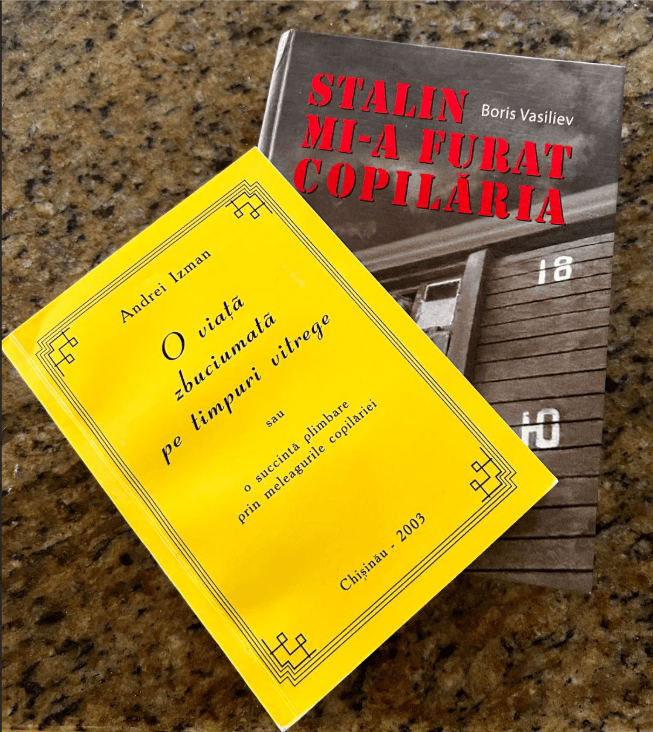
Solzhenitsyn’s book was eventually published in the late 80s, my maternal great aunt was formally posthumously rehabilitated by the state in 1990, my family is free to practice (or not practice) any religion since the late 80s and my two uncles were able to write and publish the stories of my family (Izman 2004; Vasiliev 2010). In the process, we were able to bear witness and endure.
In the late 80s, during glasnost and perestroika, Moldova experienced a growing movement for democratic reform, national self-determination, and independence from the Soviet Union. As we were reclaiming our voices after decades of silence, my maternal grandmother, ever so cautious, said to my uncle Mihai “Times may change again, aren’t you afraid of speaking up?” To which he replied, “I am tired of being afraid.” I find it both surprising and sobering that, after growing up in the shadow of those experiences, I still recognize how easily fear can reemerge when uncertainty and consequence enter the picture. Yet his words remain an aspiration: not to let fear become the author of my choices.
References
Deportari.org. n.d. “Cartea Memoriei.” Accessed June 12, 2026. https://deportari.org/#/cartea-memoriei?p=cm-fa07643179782932Izman, A. 2004. O viața zbuciumată pe timpuri vitrege sau o succinta plimbare prin meleagurile copilăriei. Tipografia Academiei de Științe a Republicii Moldova.
Solzhenitsyn, Aleksandr I. 1974. The Gulag Archipelago, 1918–1956: An Experiment in Literary Investigation. Harper & Row.
Vasiliev, B. 2010. Stalin mi-a furat copilăria. Bastina-Radog SR.
