Last week, we facilitated a workshop by the title above at the 2026 SoTL Commons, one that feels especially meaningful to us, not only because of its content, but because of what it represents. We shared the outcomes of our year-long writing collaboration focused on a question that has become increasingly urgent:
How do we continue to study difference through our SoTL work in a moment when doing so feels more constrained, more scrutinized, and sometimes more risky for SoTL scholars in the United States?
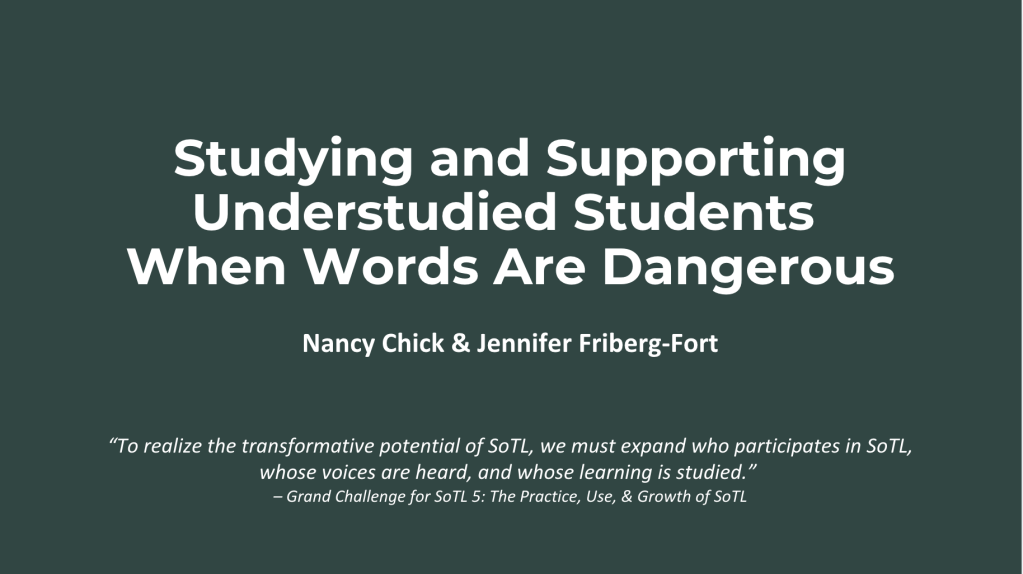
We designed the workshop to hold that tension honestly and productively. We began from a simple but powerful premise: SoTL is always contextual. Every learner, course, program, and institution is shaped by difference—whether we name it explicitly or not. Drawing on McLaren’s (1995) theorization of difference, we invited participants to think carefully about how students are positioned within their own institutional systems.
In particular, we focused on student populations that are often present in our classrooms but underrepresented in SoTL research–students described as “at-risk,” “first-generation,” “first-time in college,” “underprepared,” or otherwise situated at the margins of the academy. We emphasized the micro (individual classroom) and meso (program or departmental) levels of inquiry (Simmons 2020), both spaces where many SoTL scholars likely have the greatest agency and the most immediate impact.
Rather than offering a single “right” approach, we focused on helping participants develop context-responsive strategies that fit their institutions, communities, and roles by doing the following:
- Examining how their local contexts shape the kinds of SoTL work that’s valued, encouraged, or constrained
- Identifying student groups whose learning experiences remain understudied
- Mapping potential SoTL questions and study designs that illuminate these students’ experiences
- Brainstorming strategies for framing and sharing this work in ways that navigate the realities of the current historical moment–without abandoning our larger commitments.
Workshop Resources
To support this work, we shared a few tools and resources that grew out of our writing and planning. In the Resources section of this site, you’ll find materials connected to this workshop, including those listed to the right.
And as we prepared for this workshop, we realized that many of the materials we were creating could be useful well beyond a single conference session. That realization was part of what inspired SoTL in the States.
- Our slide deck
- A list of (more) neutral words to identify and describe some of the conditions, structures, and outcomes that affect different students differently, and so are worthy of inquiry–-but framed neutrally to navigate the current political moment
- Sample SoTL questions for studying difference
- A list of student groups to help you identify understudied students in your own institution
Our hope is that these resources support ongoing experimentation, reflection, and collaboration long after the SoTL Commons Conference ends. As we continue building SoTL in the States, we see this workshop as an early chapter in a longer story: one about community, stewardship, and the collective work of studying teaching and learning. We look forward to continuing that story with you.
–Jen and Nancy
